Hershey’s, Mars, Nestle are the major players in the chocolate industry today. These megacorporations produce chocolate cheaply and cost-efficient–through the use of slave labor. Absolutely devastating considering the noble and divine origins of chocolate from the Mayans. In Belize, we visited a chocolate making workshop in the heart of St. Ignacio. The chocolate workshop had bright green walls with posters of toucans and Mayan ruins. They had a map of the Mayan languages in their entry room. It was run by a man named Adrian.
Belize is home to the earliest Mayan settlements starting as early as 2,500 BCE in Cuello. Classical and Postclassical Mayan architecture can be found all over Belize. In fact, we visited Xunantunich, a Mayan site only 25% excavated. The Mayan civilization declined around 900 CE and lasted until the Spanish Conquest. The Mayans put up a strong fight against the Conquistadors. Today, Mayans make up about 11% of Belize’s current population. However, they still face issues with the Belizean government encroaching on their land and rights. (Gahman et al.).
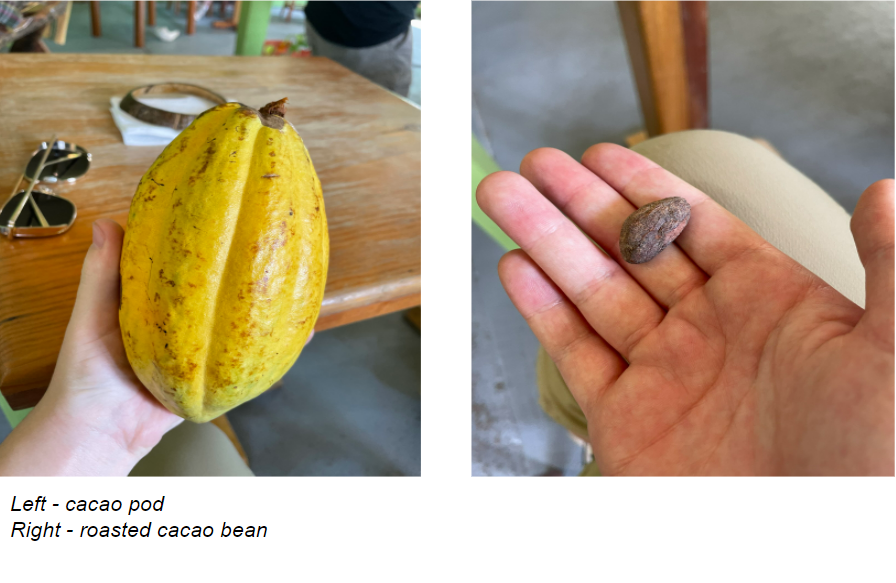
Chocolate was first eaten around 200 BCE, but it was not the chocolate we know today. The Mayans faced a bad drought and began to eat what they considered the monkey’s bean, cacao. The beans inside the pods are slimy, purple on the inside, and incredibly bitter. Adrian made us try the beans. The beans were fermented and later roasted to remove the slime and add more flavor. Adrian gave us roasted cacao beans to try, and those were delicious. They greatly resembled the dark chocolate we know and love. However, the Mayans drank chocolate hot, so they ground up the beans on a malate into a paste.
As we got to try our hand grinding the beans into the paste, I remembered seeing a malate before. Metates are a flat mortar and pestle used to grind spices and beans. They are [probably] made of volcanic rock and are very sturdy, resulting in them being passed down for generations. Metates are often found in archeological digs, especially in Mayan sites.
Belize only has one archeologist, Jaime Awe, who leads the Belize Valley Archaeological Reconnaissance Project. Archeology, especially archeology in the Americas, is something I am very passionate about. However, one archeologist per small country is often the case in the Global South. In the 1800s, when archeology became a field, it was mainly the study of the Classical Era and done by predominantly White countries. It did branch out in the late 1800s to other parts of the world with the rise of Colonialism. Not to say that archeologists are colonialists, most work hard to reframe and redirect the colonial mindset, along with promoting archeology in minority communities.
The Mayan history of chocolate also reflects its global nature. The spices traditionally added to the hot chocolate were those previously ground on the malate, usually chili, and allspice. Later, cinnamon was introduced to the Mayan chocolate from the Spanish, which reflects the global nature of the dish. The Spanish brought it to Europe where the chocolate with milk and sugar was created.
Chocolate is very important to the Mayans. The beverage itself was one for the nobility and for special occasions. Chocolate beans were the currency, which made the drink pricey. The Mayans also worshiped the goddess Ixcacao, the goddess of chocolate. Today, contemporary Mayans believe it is against the goddess and against their tradition to add sugar to chocolate.

Cacao beans and paste on metate
Similarly, the Aztecs also used the cacao bean as a form of currency in the Southern reaches of the Empire. However, they did not cultivate cacao trees and imported the beans from the Maya. They also chose to drink their chocolate cold. When I visited Mexico City with my friend, we went to the Temple Mayor Museum. The Museum featured Aztec artifacts found in the largest temple–now church–at the heart of the Aztec capital of Tenochtitlan/Mexico City. They had an exhibit on Aztec chocolate. While there was not anything to sample, they did have the spices and dyes the Aztecs used to change the color of their chocolate.
Adrian also talked about Belize’s current chocolate exports. Belize recently began exporting their chocolate. Mainly creating pure cacao and dark chocolate. However, the global economy prefers sweeter and milkier chocolate, causing Belize to add more and more sugar to their chocolate. Adrian joked about how they will soon have to create milk chocolate, but most Mayans couldn’t eat it due to lactose intolerance. They also believe adding sugar offends Ixcacao, and their heritage. It is absolutely devastating to see the Colonization of their own commodity. When most people think of Chocolate Countries, we think of Switzerland or Austria, white countries. It is devastating to see this taken from them.
