It is a lovely day in Hopkins, Belize. The hot sun is shining over Palmetto Grove, a locally run tourist destination designed to educate folks on Garifuna culture. Orioles chirp in the surrounding mangroves as a group of college girls cheer aggressively as two of their peers race to rip open a coconut. Life is good.
I am a student at Agnes Scott College, a small liberal arts college in Atlanta, Georgia. All first year students are part of a program called Journeys, where they embark on a trip to learn what cannot be taught in a classroom. My class is Pre and Post Colonial history of Belize taught by Professor Stamant. Today, we are learning about the Garifuna culture in Belize.
The Garifuna people are a group of Afro-Caribbean people historically called the Black Caribs. They are descendants of the Cari-Arawak people and the survivors of wrecked cargo ships on the island of St. Vincent. They were fierce fighters that were engaged in a century long war with the French and British. In 1797, they lost the final battle and were exiled to the Honduran cost. Many now find a home in Belize.
Palmetto Grove Garifuna Eco-Cultural & Fishing Institute is owned and operated by the Martinez family. Uwahnie Martinez gave us a tour of the site and introduced us to her family. When her father found out we were Americans, his face lit up and he asked us what we thought of the IRS. When traveling, it is important to remember that the world sees us (Americans) the same way we see the British. I keep this information in the back of my head. I don’t really see myself as an American until I travel. Nationality is not a big part of who I am, but for someone that prides themselves on their American citizenship being the butt of a joke would be surprising. Hopkins, Belize is one of the main tourist areas in Belize. It has a beautiful coast with plenty of fishing grounds. When we drove to the grove, there was an obvious shift from Tourist Belize to where the Belizeans lived.
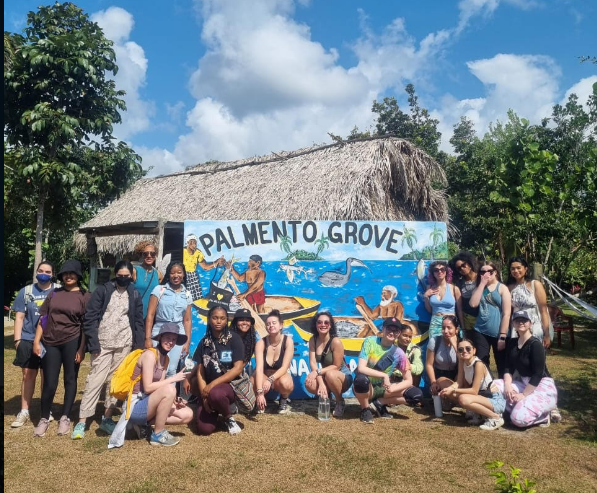
Uwahnie led us to a hut with dozens of coconuts stacked in the corner. The floor was bare with two spiked stakes sticking up from the ground. She grabbed a coconut and demonstrated how to husk off the outer shell by impaling it on the stick and rocking back and forth. Uwahnie then peeled the fibers off then rocked some more. She quickly got to the coconut nut and let us students try. Uwahnie said that husbands look for a wife that can husk a coconut, she laughed and told us that we would be very eligible bachelorettes after this exercise. Gender rules in the Garifuna community are very traditional, with women in charge of the home and men working outside. When speaking the Garifuna language, women use different words than men do. This is less strict with the younger generations, but the difference is still noticeable. Interestingly, God is a woman in the Garifuna religion.
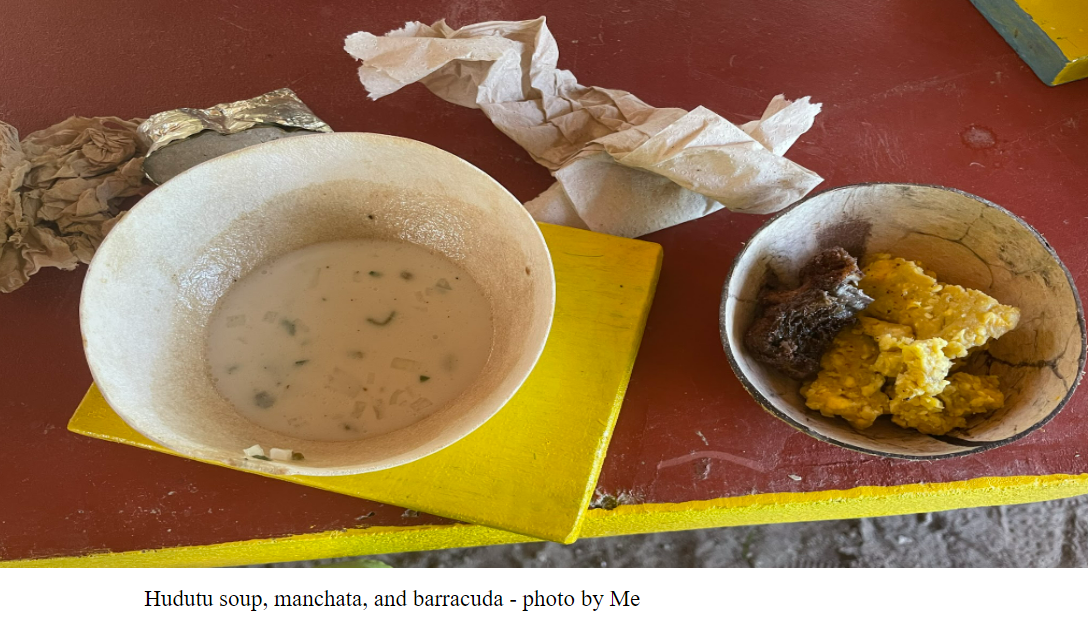
After all the coconuts were husked, Uwahnie brought us to the kitchen where we began to cook Hudut, a traditional dish of coconut fish soup and mashed plantains, complete with grilled fish on the side. Plantains are a staple in Carribean food and in Belizean cuisine. Belize considers itself both a Central American and Caribbean nation, and this is reflected in the food. Most dishes have the heat of Central American spices, but fresh fruit is always available. The plantains were boiled until soft, skin on. Uwahnie’s dad then removed the plantains from the stove and put them in a bucket, he brought out a stick and let us mash the plantains to create Manchata – mashed plantains. Manchata is West African in origin, brought over by the slaves who crashed on the Isle of St. Vincent. Uwahnie’s father also brought in a giant barracuda that he skinned and separated the meat from the bones. The fish was rubbed with cilantro, cumin, oregano, and adobo spices then grilled. The bones were set aside for the soup. We [the students] opened the coconut with a machete and shredded the coconut meat. Iwanda placed the coconut meat and water on the stove with some oregano and the fish bones. Minutes later, the Hudut was finished.
Hudut is traditionally eaten by dipping the Manchata and barracuda into the soup like a sauce. I found this absolutely delightful. The soup and Manchata had a delightful fruity flavor, especially together. The barracuda was fresh and warm. Uwahnie also had tamales wrapped with a banana leaf for us to try. The texture was different from the tamales I had in the States and in Mexico; it was thicker and more like a pudding. It is interesting to see how something so small as the wrapping makes that much of a difference.
We ended the day with a dance party. Drums were passed out to us students, but there were more Scotties than drums, so I got to dance. Drumming plays a large role in Garifuna culture with three main beats for different circumstances. We began with the slow and steady Ugu Hugu beat which is used for religious celebrations. The dance was mainly stepping side to side. We then switched to the soulful Paranda, which focuses on struggles within the community. The beat was faster, which reflected in our footwork. The Punta is the fastest of the Garifuna beats, and requires the dancers to “shake what your mama gave ya.” Punta is played at parties; we actually witnessed it the night before at a local restaurant. The dance requires a lot of quick stepping and shaking hips. Much of the Garifuna identity is tied to music and drumming, and I am very happy that I got to experience a fraction of it at Palmetto Grove.
