Tapioca, yuca, manioc, arrowroot. A starchy root vegetable that apparently has a nutty flavor. The Portuguese introduced Cassava to Africa in the late 15th century, and it plays a similar role in West African culture and in Garifuna culture. In Belize, they call this tuber cassava and it is a staple in the Garifuna diet. Cassava has many uses; a lot of them stem from the Cassava flour. My class and I traveled to Sabel’s Cassava Farm alongside Iwanda from Palmento Grove to learn how to make cassava bread.
We began with a tour of the farm. Cyril Sabel Jr, one of the owners of the farm, showed us the hut most of the work was done in. There were flat stoves, machines, and lots of cassava root. Afterwards Jeneve Sabel brought us to the fields to begin harvesting the roots. We were going to make cassava bread from the ground up.
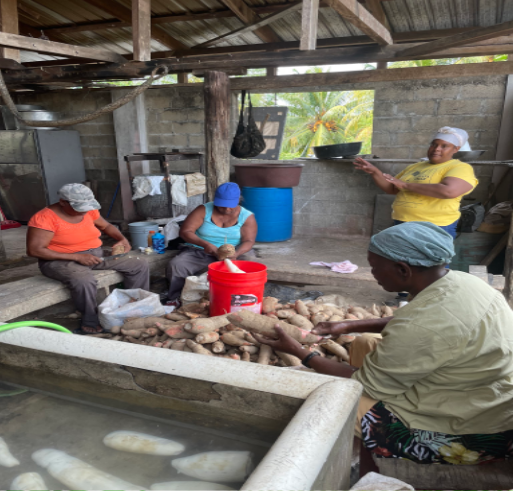
Sabel’s Cassava farm is located just off of Hummingbird highway, in the heart of the Garifuna community. It is a family owned-and-operated business that spans three generations. I really appreciate all of the places I got to go on Journeys. If I were going to Belize on my own, I doubt I would learn this much nor visit ethical places. This class taught me the benefits of ethical travel firsthand and allowed me to line the pockets of Belizean business owners, which I greatly appreciate.
The day was warm and bright in the fields. Jeneve and Cyril demonstrated how to remove the underbrush from around the cassava tree. Jeneve cut the top of the tree and then began to dig for the roots. Afterwards it was our turn. I happily took the opportunity to swing a machete and began removing the vines and twigs around the trees. As a child, I really enjoyed gardening with my parents, although none of us continued after a couple years. I appreciate the occasional manual labor, but I am the grim reaper of plants. I felt my skill at killing plants was very useful at the farm.
After the harvest, Jeneve brought us back to the hut to remove the skin from the cassava. We used knives to peel the cassava like a potato. Sabel Cassava Farm grows two types of cassava – sweet and bitter – the bitter is used in the bread and flour. We harvested the sweet cassava, which was also easier to peel. The skin came off in one swoop of the knife. A group of Scotties (us students) were also tasked with cleaning the peeled cassava. They removed dirt and nicks from the skin of the cassava.
Jeneve brought out these boards full of tiny stones in the drilled holes. She placed the boards into a bucket. We grated the cassava into the bucket beneath by sliding the cassava up and down. After we all had our fair share of the workout, Jeneve smiled and said “this is how we process it now.” Her nephew then turned on one of the machines which began to quickly grate the cassava. Uwahnie told us that back in the day the cassava had to be separated into what is edible, what is baby food, and what is cyanide. Today, they have a machine that dries the cassava, which removes the cyanide. The machines were handmade by Cyril Sabel Sr., the father of Cryil and Jeneve, and they were preserved for a generation. Jeneve states that she is happy to be the third generation of farmers because “most of the hard work was done by her parents and grandparents.” The two machines were for shredding the cassava and for sifting and drying.
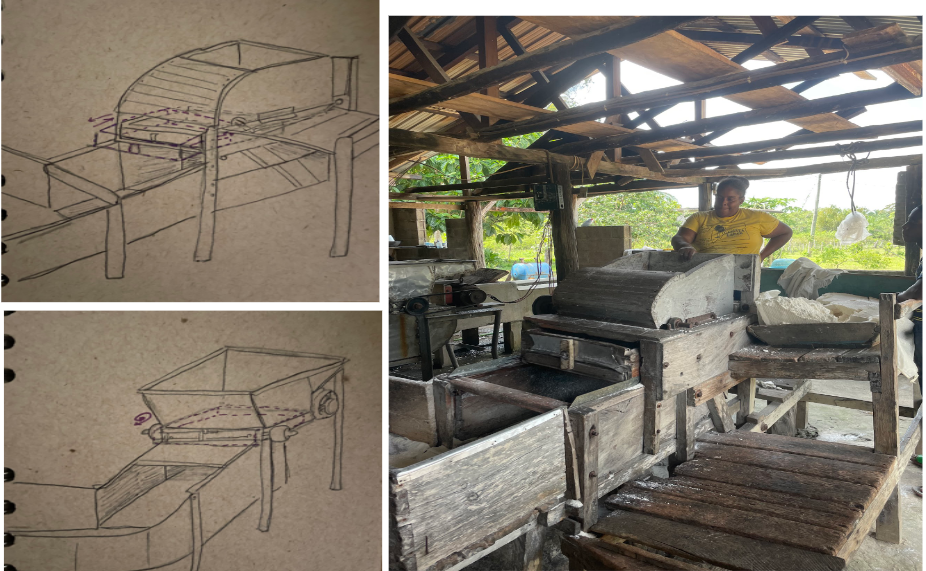
Bottom Left – diagram of how I think the cassava shredder works.
Right – Jeneve standing behind the cassava drier.
Finally, it was time to make the bread. Jeneve directed us to her mother who instructed us. She stood over a flat oven and sifted flour onto its surface. She then patted the cassava flour down and added more. Jeneve’s mother picked up a broom-like object and whacked the cassava flour, which had hardened. She flipped it over and repeated it on the other side. I did not expect her to whack the bread, but I was eager to try my hand. After a couple classmates had made bread, it was my turn. I sifted the flour, flattened it, added more flour, whacked it, used a piece of wood to flip it, then I took it off the heat. I tried to carve a jack o’lantern-like face into the bread, but I could not get the triangles.

The bread is thin like hardtack. The texture is similar to a saltine cracker. It is both crunchy and chewy, and the flavor resembles a granola bar, but with a tang of bitterness. We made our bread with the 100% dry flour, which is used for most things. Cyril said that they also make 85% dry flour but I cannot remember its uses.
Reading A Small Place by Jamaica Kincaid made me aware of just how ugly the tourism industry can be. Tourists witness Antigua’s natural beauty, but miss the hardships the people go through. We witnessed this divide in Hopkins, Belize when we passed through the “nice” touristy part of town, with the expensive hotels. Kincaid reflects on her childhood library which lies dilapidated, and worries for the state of her country. The tourists don’t notice that, nor the lives of the people they interact with. While none of the people I interacted with in Belize expressed their worries for their country’s future to me, I did notice some divides from Mercedes to the people on bicycles. Just like America. While traveling, I am happy I got to experience a real Belizean business and learn Belizean methods of cooking.
